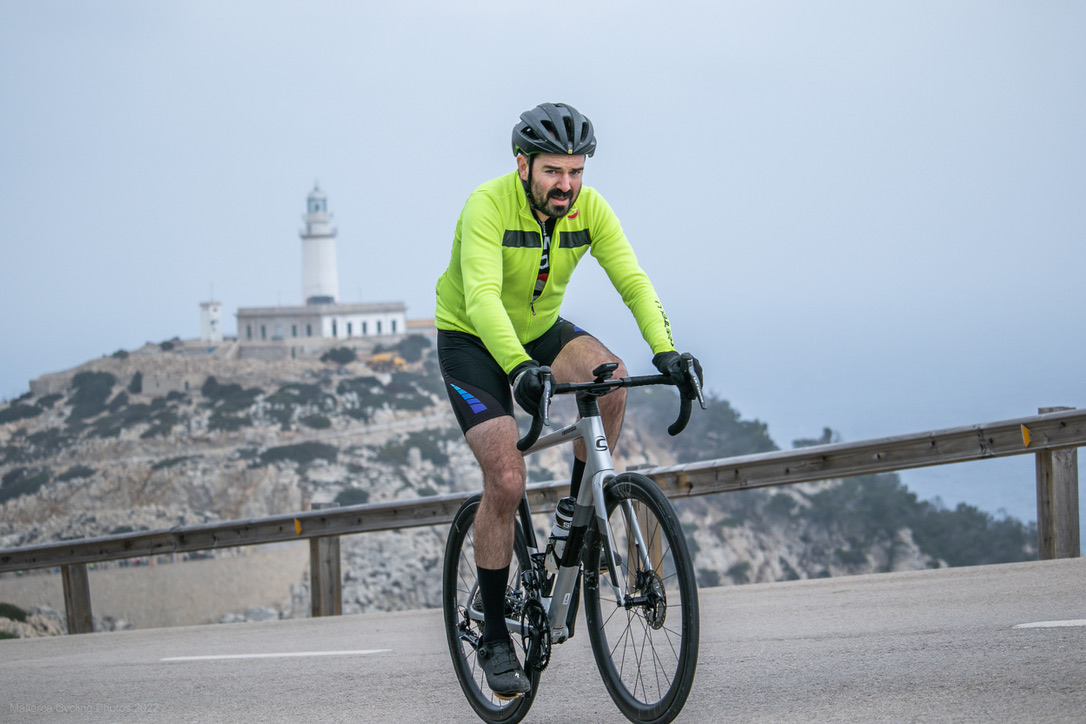
There's a road on the north coast of Mallorca that cyclists talk about in hushed tones. Sa Calobra — the Coll dels Reis — peels off the Serra de Tramuntana in a cascade of impossible switchbacks, even tying itself into a literal knot before dropping all the way to the sea. The catch: the only way back out is to climb it. Nine and a half kilometres, around 7% the whole way, no flat to hide on and no excuses to make.
This spring I rode up it faster than I ever have. Two minutes faster — and on a climb like this, two minutes is an eternity. The strange part? I did almost none of the work on Sa Calobra. I did it in my garage, on a turbo trainer, through a grey British winter, staring at a number that barely moved.
That number was my heart rate. And holding it there was the entire point.
The unglamorous truth about getting faster
Everyone wants the workout that makes them fast. Intervals, threshold blocks, the sessions that leave you on the floor. They have their place — but they're the icing. The cake is Zone 2: long, easy, aerobic riding at an effort you could hold all day and still talk in full sentences.
It's where the boring, permanent adaptations happen. More mitochondria, denser capillary beds, a body that learns to burn fat instead of torching its limited sugar stores. It's why the pros spend roughly 80% of their training going slow so the other 20% can go properly fast. Build the engine first; tune it later.
There's just one problem with Zone 2 on a trainer: it's deceptively hard to actually stay in Zone 2. Hold a fixed wattage and your heart rate quietly drifts upward as you fatigue. Chase a fixed heart rate by feel and you're forever fiddling with resistance. Either way you drift into the no-man's-land of Zone 3 — too hard to build base, too easy to build top end. The grey zone. The place where junk miles are made.
Letting the app hold the line
This is the exact problem I built Justzone2 to solve. Pair the Wahoo KICKR, set a target, and a PID controller does the babysitting: it shaves a few watts off when my heart rate creeps above the zone, and feeds them back in when it settles. I don't manage a number. The bike manages it for me, second by second, for the whole session.
So that's what winter looked like. Four or five sessions a week, 45 to 60 minutes each, heart rate locked around 142 bpm while my mind wandered off to a podcast. My Strava feed became a wall of flat, unremarkable grey lines. Nothing to screenshot. Nothing to brag about. Just the engine getting quietly, stubbornly bigger.
I'd spent four months learning exactly what my body felt like at 142 bpm. On the climb, I just… rode there.
And then, Mallorca
You don't notice base fitness arriving. You notice it the first time a familiar effort feels suspiciously easy. Rolling out from Port de Pollença on day one, the legs felt… different. Calm. Like they had a much deeper well to draw from than I remembered.
Then came the climb. You descend Sa Calobra first — eleven dizzying kilometres down to a tiny cove pinched between cliffs — which means the entire time you're grinning at the scenery, a small voice reminds you that every metre has to be paid back. At the bottom you turn around, clip in, and start the toll.
I settled into the rhythm I knew better than any other: that steady, sustainable, talk-in-sentences effort. And here's the magic of a winter spent in Zone 2 — the effort that used to be my threshold now sat comfortably just above the zone I'd lived in for months. Same heartbeat I'd trained at all winter. But this time it came with a lot more watts underneath it.
Through the knot. Past the riders who'd gone out too hard and were now paying in full. The gradient never relents on Sa Calobra, but for once it felt like a conversation instead of an argument. I crossed the top, checked the watch, and laughed out loud on an empty mountain road. A new PR by two minutes and eleven seconds.
What the base actually buys you
None of this is magic, and that's exactly why it works. A winter of Zone 2 didn't give me a bigger heart rate to push to — it gave me a bigger engine to put behind the same one. More mitochondria turning more fat into more power, lactate cleared before it ever piled up, fatigue arriving later and softer. Identical effort, more speed.
Zone 2 is the least exciting way to get faster and almost certainly the most reliable. The hard bit was never the climb. It was showing up in a cold garage, four times a week, to ride at a pace slow enough to feel like nothing was happening. Justzone2 just made sure that every one of those boring minutes actually counted.
Next winter starts the same way. Grey. Quiet. Locked in. I can't wait.